

The Lab Opera XXI is a platform for the development of contemporary opera, stemming from the Opera XXI Marathon competition, focusing on various aspects of opera composition and production. It thus invests in the training, professionalization, and promotion of contemporary opera, also through a multidirectional approach with multidisciplinary initiatives intrinsic to this total art form, contributing to pointing out new paths and trends for opera of the present and the future.
In 2026, LOXXI will invest in deepening the work of composers and librettists for the composition of new operas, as well as in masterclasses in vocal technique and stage work for emerging singers, and masterclasses and workshops that address the body in a holistic vision and as the main instrument of the performer in a comprehensive way.
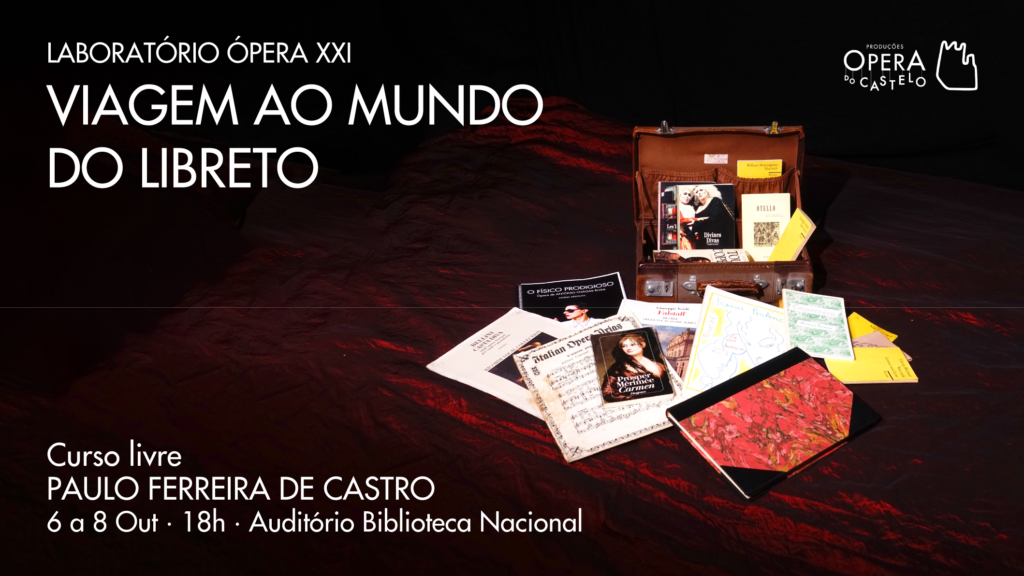
Free course by Paulo Ferreira de Castro (in Portuguese)
October 6 to 8, 6:00 PM
Auditório da Biblioteca Nacional de Portugal
Free admission, but registration is required via the form (here).
Exploring the Evolution and Characteristics of the Libretto – the Dramatic Text at the Heart of Opera
“Who writes, who decides, how a text is transformed through its encounter with music.”
The Ópera do Castelo presents, as part of Lab Opera XXI – Platform for Today’s Opera, a free course aimed at professionals in the sector and anyone interested in deepening their knowledge of opera’s dramatic text – the libretto: its fundamental characteristics, its evolution over time, and its various forms and types.
The libretto is the dramatic text of opera, its skeleton: the text through which music becomes sung words and a plot brought to life on stage. The partnership between composer and librettist is essential. Inspiration from, and adaptations of, literary works are a constant throughout the history of opera.
The course proposes a journey through the history and evolution of the libretto, from the birth of opera in Italy at the dawn of the 17th century to the present day. It will explore paradigmatic and innovative librettos from different periods, as well as seminal collaborations such as Monteverdi and Busenello (The Coronation of Poppea), Mozart and Lorenzo da Ponte (The Marriage of Figaro, Così fan tutte and Don Giovanni), Verdi and Arrigo Boito, and, more recently, in the 20th and 21st centuries, Kaija Saariaho and Amin Maalouf. The unique and visionary case of Wagner will also be addressed, alongside operas based directly on literary works, such as Alban Berg’s Wozzeck, based on Georg Büchner, or Richard Strauss’s Salome, based on Oscar Wilde, among many others.
A Closer Look at the Libretto – Itinerary
This three-session series offers an introduction to the opera libretto as a specific literary genre, following some of its main historical and aesthetic transformations. Starting with the evolution of the genre, the sessions will address questions of metre and versification, as well as the gradual transition from poetry to prose and the different ways in which words and music are articulated. Attention will also be given to the relationship between writing and singing – between the written text and its vocal realisation – and to the way in which the libretto contributes to the construction of theatricality and dramaturgy in opera and related genres.
Across the three sessions, concrete examples will be analysed, allowing participants to explore different formal and dramaturgical solutions, including adaptations of pre-existing theatrical and literary texts into librettos. Particular attention will also be paid to the processes of collaboration, negotiation and conflict between composers and librettists: who writes, who decides, how a text is transformed through its encounter with music, and what tensions may arise between literary autonomy and musical and scenic requirements.
Finally, the sessions will address some of the challenges facing libretto writing today, in a context where opera is exploring new relationships between languages, forms of vocality, dramaturgies and modes of collective creation. The course will therefore seek to understand the libretto not merely as a verbal support for music, but as a specific space of invention, mediation and tension between literature, composition and theatre.
Paulo Ferreira de Castro
Paulo Ferreira de Castro
(Musicologist)
Paulo Ferreira de Castro studied musicology in Strasbourg and London, completing his PhD at Royal Holloway College. He was a lecturer and Executive Coordinator of the Department of Musical Sciences at NOVA FCSH. Between 1992 and 2000, he held senior positions at the Teatro Nacional de São Carlos, first as Artistic Director and later as Administrator and Director. He was a co-founder and the first President of the Sociedade Portuguesa de Investigação em Música (SPIM), and President of the Board of the Centro de Estudos em Música da FCSH (CESEM). Since 2022, he has been a member of the Directory of the International Musicological Society (IMS), based in Basel.
He was a music critic for the weekly newspaper Expresso and is the author of studies on the history, aesthetics and criticism of music from the 18th to the 21st centuries, published in several languages. He has participated in numerous conferences and given lectures in Portugal and abroad, including in France, Italy, Austria, the United Kingdom, the USA, Canada, Poland, Russia, Lithuania, Serbia, Romania, Greece, Spain and Brazil. As a researcher, he has devoted particular attention to theories and practices of musical signification and to the relationships between music and philosophy.
Production: Ópera do Castelo